Archive for category Daily Capitol News Updates
Election Laws
Posted by Virginia Public Radio in Daily Capitol News Updates on December 21, 2011
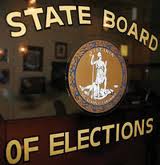 Bills to allow absentee balloting for any reason and to provide more voting options for deployed military personnel and are just some of the measures that have already been filed for next month’s General Assembly session. State Board of Elections Secretary Donald Palmer says lawmakers have several reasons–in addition to passing any needed reforms–to work expeditiously.
“2012 is going to have a number of elections–the Presidential preference primary including the primary for Congressional seats. Obviously, redistricting we’ll be facing again–it appears with the Congressional seats. And then the 2012 General election. And so, 2012 General election will be a test. It always is—it really tests the system because we have a larger turnout than normal and part of what we do is just prepare for that,” said Palmer.
Analysts believe Virginia could again play a pivotal role as a swing state in deciding who’s in the White House. Palmer says that’s even more incentive to make sure that everything runs smoothly, and that voters are educated about candidates, polling places, and alternatives—especially if turnout is close to 2008’s record-breaking numbers.
–Tommie McNeil
Assisted Living Communities
Posted by Virginia Public Radio in Daily Capitol News Updates on December 20, 2011
 ‘Assisted living’ was a relatively new concept 25 years ago but is now the most preferred long-term care option for the growing population of seniors. However, costs and restrictions often limit access to many.
Assisted living communities provide 24-hour supervision and limited health care to thousands of seniors and disabled Virginians. To live there, many residents must use federal benefits and Medicaid, and some also receive a small state auxiliary grant. The Joint Legislative Audit and Review Commission’s Walt Smiley told lawmakers that if community groups or families want to help financially, that could jeopardize eligibility for benefits.
“Payments from third parties cannot be used for food or shelter. These are the federal rules. And to use money from third parties for a private room or to provide better food, for example, would likely disqualify the individual from continuing to receive those benefits and maybe from Medicaid as well,” said Smiley.
But he said third-party payments for services such as medicines, eyeglasses, or dental care, would not hurt eligibility and could be helpful.
“The recipients have a significant problem paying for dental services. Many Auxiliary Grant residents get their teeth pulled instead of fixed because it’s all they can afford,” he said.
JLARC’s report proposed state legislation to clarify that third-party funds can be used—but not for room and board.
–Anne Marie Morgan
Proposed 2013-2014 Virginia Budget
Posted by Virginia Public Radio in Daily Capitol News Updates on December 19, 2011
 Governor McDonnell has unveiled a proposed $85-billion state budget for the 2013-2014 biennium. As promised, it plows an additional $100-million per year into higher education and $2.2-billion into the Virginia Retirement System.
To prepare for federal budget cuts and preserve the state’s high credit rating, the Governor adds dollars to a new contingency fund. His plan also requires school divisions to report how much money is spent in the classroom.
“This budget includes $438 million in total new state spending for public education during the biennium,” said Gov. McDonnell.
That total includes state pension funds. He also invests more in economic development and job creation, which Democratic Senator Janet Howell supports along with the higher ed and pension funding–but Democrats oppose the Governor’s phasing in a larger share of the sales tax for transportation maintenance.
“We do not and will not support transferring General Fund monies to transportation. And, I would point out that the Lieutenant Governor is not allowed to vote on the budget,” said Howell.
McDonnell increases funds for Medicaid, which now consumes one-fifth of the General Fund, but does not fund the inflation rate for providers. The plan calls for some higher DMV fees but has no tax increases.
— Anne Marie Morgan
Richmond Free Press
Posted by Virginia Public Radio in Daily Capitol News Updates on December 19, 2011
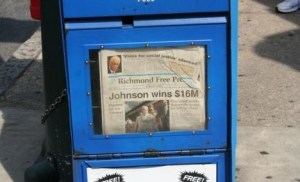 In the age of blogs, Twitter and Facebook, Americans seemingly have endless options to express their views. But that doesn’t mean those opinions are welcomed. the burning of Richmond Free Press newspapers this fall didn’t just damage private property— it also infringed on the paper’s rights to free expression.
Publisher Ray Boone says efforts to stifle the paper’s progressive views have occurred for 20 years. His newspaper boxes have been run over and papers shredded. Businesses have refused to allow his boxes outside their doors. No single person or group appears to be responsible. But Boone says historically, black papers have been banned and the community has been deprived of access to information, and that battle is still not won.
“ A major test of a nation’s freedom is the degree of liberty that the people have to speak, write and publish. Based on that premise Richmond does miserably and the national generally flunks,” said Boone.
No one has been charged with burning the papers. The Virginia ACLU’s Rebecca Glenberg said regardless of the motive, the vandal limited the paper’s voice and prevented readers from hearing those views and information.
–Amanda Iacone
State Agency Advises Against Cutting Retirement Benefits
Posted by Virginia Public Radio in Daily Capitol News Updates on December 13, 2011
 Cutting retirement benefits or requiring state employees to make larger pension contributions could jeopardize Virginia’s ability to recruit and retain a skilled workforce.
That’s one conclusion of a Joint Legislative and Audit and Review Commission study, which evaluated the state’s retirement programs and related options. The watchdog agency also found the state will need to step up to the plate to maintain the long-term health of its pension fund.
Due to declining investment returns, the Virginia Retirement System Board has called for higher contribution rates.
To assess the feasibility of requiring a larger employee share, JLARC compared the value of state salaries and benefits to those of other employers who compete for the same workforce. JLARC Project Leader Tracey Smith said salaries were not competitive.
“The benefits package provided to employees IS competitive. And its value is higher than the median provided by other employers. The value of the state’s benefits package helps the state remain marginally competitive despite the low relative salaries.”
The report also found that the state has underfunded its share.
“The report concludes that requiring greater employee contributions before the state has made progress toward paying its portion of the benefits’ costs would be viewed by employees as unreasonable. And it would have the greatest negative impacts on the state’s recruitment and retention objectives.” But Smith said some changes, such as lower cost-of-living adjustments, could save money. However, providing alternatives such as an optional 401-K-type plan may not, since only a small number of workers would choose that option.
–Anne Marie Morgan
Casting the Tie Vote
Posted by Virginia Public Radio in Daily Capitol News Updates on December 9, 2011
 A Richmond Circuit Court heard arguments today in a lawsuit filed by State Senate Democrats, who say the GOP Lieutenant Governor does NOT have the right to cast a tie-breaking vote on organizational matters when the General Assembly convenes next month. The Senate will be evenly divided between the two major parties, and Democrats are asking the court to step in before the decisive legislative votes are cast.
Since Senate Democrats lost two seats in last month’s elections, Republicans have said the Lieutenant Governor’s power to cast tie-breaking votes also applies to rules that include who serves on specific committees. During the hearing, Lieutenant Governor Bill Bolling’s attorneys argued that he has sovereign immunity and is an officer of the Senate. They also said Democrats can’t seek an injunction prior to a tie vote that needs Bolling’s intervention. Democratic Senator Donald McEachin, says his caucus and voters are right to be concerned.
“The rules are likely to be written in such a way, so that is takes a super majority to undo them, and we won’t be able to undo the rules after session. Moreover, there would be legislation that would pass a majority Republican committee that might pass an evenly divided committee and those things are going to effect—the Attorney General’s office is suggesting that the best way to undo that is to have individual litigants start suing after it happens. That’s a colossal waste of judicial resources,” said McEachin.
Judge Beverly Snukals is expected to rule next week.
–Tommie McNeil
Tie One On For Safety
Posted by Virginia Public Radio in Daily Capitol News Updates on November 27, 2011
 Mothers Against Drunk Driving and police are teaming up now and through December to make the public more aware—and cut down on alcohol-related crashes.
MADD has rolled out a “Tie One on for Safety” campaign asking Virginians to place red ribbons on their cars to raise awareness against drunken driving.
The ribbons are available at ABC stores. MADD is also asking each Virginian to “give the gift of yourself” as a designated driver… and download a gift coupon from its Website. Law enforcement agencies will saturate the roads throughout the holidays.
–Tommie McNeil
Shrinking State Government
Posted by Virginia Public Radio in Daily Capitol News Updates on November 27, 2011
 Governor McDonnell has announced a package of initiatives that would reorganize portions of state government. The legislation is heading to the General Assembly as part of a continuing effort to shrink the government’s size.
McDonnell rolled out his recommendations Tuesday based on the work of his government reform commission. He said state spending grew 23% during the past decade—when adjusted for inflation—and that in this economy, Virginians can’t afford a government that grows bigger each year.
The plan would eliminate 19 state boards and commissions and combine as many as 23 others. It would get rid of the Surface Mining Review Board and the Public Broadcasting Board … as well as de-regulate several professions, including hair-braiders and interior designers.
The Governor also proposes scrapping the National Defense Industrial Authority and the Board of Towing and Recovery Operators, since they duplicate work handled by other state agencies. The changes are estimated to save as much $2-million a year.
–Amanda Iacone
Where’s My Mail?
Posted by Virginia Public Radio in Daily Capitol News Updates on November 27, 2011
 If you’re sending holiday cards or packages to Central or Southeastern Virginia, they might not arrive in time. Nearly nine months ago, the U.S. Postal Service issued a report finding significant delays for customers served by its distribution center near Richmond, with 54 million pieces of delayed mail in the first quarter of this year.
When the U.S. Postal Service began consolidating operations, officials said they could continue to provide timely delivery, but some customers say that hasn’t happened. Dan Rosenswieg is executive director of Habitat for Humanity in Charlottesville – a non-profit that mailed its semi-annual newsletter in October. After two weeks, the group began calling the post office to find out what had happened to those mailings.
“They’re sitting somewhere in that warehouse, but they couldn’t give us any time or any estimate as to when they’re going to go out, and now by the time, even if it does ship tomorrow, the news is going to be pretty late,” said Rosenswieg.
Now, Rosensweig is worried about the annual request for funds. A similar mailing went out in early December of last year but didn’t arrive until after January first.
“This is the primary time of year when people make charitable gifts. First of all it’s the spirit of the season, but second of all people are eager to get their taxable contributions in prior December 31, and when they don’t get their end-of-the-year appeal letter prior to January 1st, we’re likely going to have a lot of people who just choose not to donate.”
The internal postal service probe concluded the Richmond center was understaffed by about 70 clerks and maintenance workers, and six management positions were vacant. A new plant manager took over in mid-summer, but a spokeswoman for the postal service says “you don’t turn an ocean liner on a dime.” Michele Martel added that the center is the size of 12 and a half football fields and processes up to seven million pieces of mail in a 24-hour period.
— Sandy Hausman
Advisory Council on Revenue Estimates
Posted by Virginia Public Radio in Daily Capitol News Updates on November 22, 2011
 Just hours after returning from his trade mission to Israel and India, Governor McDonnell met privately with his Advisory Council on Revenue Estimates. The group of public and private-sector leaders are helping the Governor gauge the levels of economic activity expected over the next two years and the revenues that the state could expect to reap as a result.
For 19 of the past 20 months, state revenues surpassed those of last year. Nevertheless, officials are saying they won’t be sufficient for rising costs in public education, Medicaid, and the state pension fund. Governor McDonnell said other challenges will also have an impact.
“Just returning from an overseas trip, I certainly can tell you that the rest of the world is concerned about the U.S. economy, is concerned about the unpredictability and uncertainty that’s coming out of Washington. We saw that yet again this week with the failure of the Super Committee to do what it was instructed to do. There are crises in Europe and other places with debt and deficits that certainly have an impact on the U.S. economy,” said McDonnell.
He said none of the economists consulted had a rosy outlook.
“There were seven of them that recommended the standard forecast, five that chose the ‘standard-minus,’ and two recommended the recession scenario for the U.S. economy.”
Some officials say budget cuts will be needed, but will likely be targeted and not across-the-board. Agencies have been preparing 2, 4, and 6% reduction plans. The Governor unveils his budget in December.
–Anne Marie Morgan
Power Sharing in the Senate?
Posted by Virginia Public Radio in Daily Capitol News Updates on November 22, 2011
 Virginia Democrats say they’ll go to court to try and force Republicans to accept a power sharing arrangement in the state senate. The chamber will be evenly divided between the two parties when it convenes in January but Republican Lieutenant Governor Bill Bolling will be there to break tie votes. Fred Echols reports.
Police Lineups
Posted by Virginia Public Radio in Daily Capitol News Updates on November 18, 2011
 The Virginia State Crime Commission wants police officers to implement a more uniform approach when using lineups to identify suspects. But even after studies have been performed to help make that happen, only some progress has been made.
A number of factors impact how effective police lineups are for catching and prosecuting criminals. A witness must be able to accurately identify a suspect without manipulation. Depending on whether it’s a photographic or live lineup, photos must be clear enough for witnesses to distinguish specific characteristics, or the pool of possible perpetrators must be chosen without profiling. But only 74% of law enforcement agencies have uniform policies.
“You know we took this course because we didn’t want to invalidate a bunch of prosecutions and the thought would be that law enforcement agencies want to do the right thing and when you show them best practices they would slowly segue into that. This is is moving more slowly than I think we would have thought,” said Crime Commission Vice-Chair, Delegate Rob Bell.
Department of Criminal Justice Division Director Teresa Gooch says one challenge is making sure that new officers know the policies from the outset.
“I think it’s training and our ability–DCJS’s ability to reach out and to actually, work with the training academies because that’s where the foundation of all training starts–is at the academy,” said Gooch.
–Tommie McNeil
Governor McDonnell’s Trade Mission
Posted by Virginia Public Radio in Daily Capitol News Updates on November 17, 2011
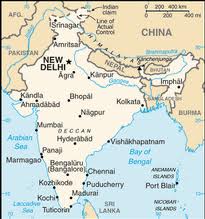 Governor McDonnell is now in India as he wraps up the final leg of a trade trip that began in Israel. He says the discussions there have been very productive and the Governor is lauding the benefits of taking more Virginia products to an emerging nation with more than a billion consumers.
India is a valuable market for Virginia, which exported $293 million in goods to India last year. McDonnell said 52% of all Indian workers are engaged in Agriculture, and since it’s the largest Virginia industry, it was a major focus of trade discussion. The Governor told reporters on a conference call that he’s already met with 60-major business leaders to explain the advantages of foreign investments in Virginia.
“Since then we’ve met with several of the major Indian businesses that already have offices in Virginia and I talked to them about expansion and job creating opportunities in our state,” said Governor McDonnell.
With him is Secretary of Agriculture Todd Haymore, who discussed what agricultural imports piqued the interests of Indian business leaders.
“We’ve also been meeting with apple importers and process food importers. It’s a very, very strong market for imported apples to India and obviously Virginia. Apples are one of our top commodities. Meeting with a number of importers of soybean oils–oils that are coming from crushed soybeans, obviously which we’re producing a great number of in Virginia,” said Haymore.
The Governor said the trade delegation also advanced the state’s wine, tourism, bio-tech, nanotech, and film industries.
–Tommie McNeil
Senate Seat Lawsuit Filed
Posted by Virginia Public Radio in Daily Capitol News Updates on November 16, 2011
 The Associated Press and the Virginia Capitol Correspondents Association are being sued after some qualifying rules have excluded U.S. Senate candidates from a debate next month at their annual AP Day at the Capitol. And while similar suits have been filed in the past with little success, the candidate who filed the petition this week says the federal lawsuit brings to light an issue of fairness to voters and whether or not some entities are making a mockery of democracy
Eight Democrats and Republicans are running for the seat of retiring U.S. Senator Jim Webb. The debate rules state that to participate, a candidate must have achieved 15% in primary polls, and raise at least 20% as much money as the parties’ front-runners. Democrat Tim Kaine and Republican George Allen are only ones who have qualified. But, Democrat Julien Modica believes his civil rights have been violated–and the voters’ right to more options and an awareness of ALL issues, even within the parties, is being denied.
“We had the Tea Party, now we’ve got Occupy Wallstreet, you know in light of these two groups that are just outraged by what government has done, why would I just sit around and say ‘Ok, you guys have been here, you both have been governors, one has been a Senator, one was the chairman of the DNC, why would I just sit here and allow you to take over?”‘ said Modica.
Modica says both Allen and Kaine have shown how they will lead and that may not be what voters need now–but the VCCA and AP are essentially deciding for the voters.
As the debate approaches in December, Virginia Public Radio will air in-depth features with each candidate allowing them to introduce themselves to the voters and discuss the issues they believe are most relevant.
–Tommie McNeil
Tax Preferences
Posted by Virginia Public Radio in Daily Capitol News Updates on November 15, 2011
 Virginia lawmakers are evaluating whether all of the state tax preferences enacted over the years are being effectively used—as well as their potential impact on revenues. The Joint Legislative Audit and Review Commission has identified 187 credits, deductions, sales tax exemptions, and other tax breaks … but the watchdog agency says only some work the way they were intended.
Many tax preferences, such as sales-tax relief for food, were enacted to achieve policy goals of providing financial assistance or promoting desirable activities. In 2008, they reduced taxpayer liability by $2.9 billion. But JLARC Project Leader Ellen Miller said some to provide tax breaks for people with lower incomes also helped others:
“Only two preferences, the age deduction and low income tax credit, did so efficiently and provided the majority share of the reduced liability to intended beneficiaries,” said Miller.
Miller said the land conservation and historic rehabilitation credits did promote those activities. Tax breaks to help save for college were only somewhat effective. “In contrast, we found that preferences promoting the coal industry, nonprofit activity, and long-term care insurance were unlikely to achieve their goal.”
The worker retraining credit was too small to promote retraining. The report recommends creating an oversight panel to assess all preferences. Some advocates are calling for repeal of tax “loopholes”—to fund services with the revenue that’s saved.
–Anne Marie Morgan
Project Citizen
Posted by Virginia Public Radio in Daily Capitol News Updates on November 14, 2011
 Surveys consistently show that the vast majority of Americans fail basic tests of civic literacy. That’s one reason why a General Assembly commission sponsored a Civics Education Summit in Richmond attended by teachers from across the Commonwealth. They discussed practical ways to help students learn political knowledge—while capturing their imaginations.
A major theme was the effectiveness of teaching and learning methods. For example, when students read, they remember about 10% of what’s read. Hearing results in a 20% retention rate. But students who discuss material remember 70% … and when they also do an activity, they recall 90%. Henrico teacher Kathryn Niemeier is a trainer for the civics education program, Project Citizen. She said hands-on learning is essential for mastering civics knowledge.
“And that’s what Project Citizen really does. It explains to students how you can participate in the process effectively, get your voice heard. You don’t always get the outcome you necessarily want. But you get your voice heard. But it’s a way of participating outside the most common form which they hear about—that’s voting,” she said.
Niemeier also said learning dispositions, such as respect, accountability, and political efficacy are also critical. She added that research, oral language, and other skills acquired through an active approach will also transfer to other subjects.
–Anne Marie Morgan
Labor Trends in Virginia
Posted by Virginia Public Radio in Daily Capitol News Updates on November 10, 2011
 The Commonwealth Institute for Fiscal Analysis has unveiled the latest in a series of studies that identify issues in Virginia that hinder economic growth. The most recent study examines the labor force—and how well the state has rebounded since the economic recovery began in June, 2009. Michael Cassidy there says Virginia has a long way to go before it rebounds to pre-recession levels. Compared to past downturns, the number of job losses continued to grow.
“So unemployment, for example, rose by 14% in our state last year, and that was the largest jump in the whole South Atlantic region,” says Cassidy.
More than 1 in 3 unemployed workers looked for jobs for more than 27-weeks. The state remains 128,000 jobs below pre-recession levels .In addition, underemployment remains a problem …as some who obtain jobs work only part-time or below their skill levels. Cassidy says to help workers get back to pre-recession levels—the state could raise the minimum wage, provide training for new skills, and enact more earned income tax credits.
–Tommie McNeil
Trade & Politics
Posted by Virginia Public Radio in Daily Capitol News Updates on November 9, 2011
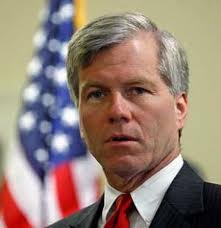 Just hours after celebrating a historic day of elections in Virginia and the Republican Party, Governor McDonnell embarks on an 11-day trade mission to meet with leaders in India and Israel, including Israeli Prime Minister Benjamin Netanyahu. But some say Virginia’s success abroad and its recognition as the most business-friendly state in the U.S. has been, in part, because of its diversity and ability to incorporate various ideas, regardless of party affiliation, into business concerns. And with one party in power in Richmond, the Governor still thinks other nations will view the Commonwealth in the same light.
If the election results are confirmed, the GOP would have the largest majority in history in the House of Delegates and a working majority in the Virginia Senate. Republicans also hold all three statewide offices. McDonnell says all interests will still be represented as the state moves forward, but he believes there will be less gridlock on some key issues that may have prevented the Commonwealth from focusing on business expansion and job creation.
“The whole goal there, regardless of whose in charge back here in Richmond, my whole goal is to bring more jobs and opportunity in Virginia. I want more direct foreign investment, I want them to open up their foreign markets and to buy more things from Virginia–hopefully convince a lot of people in both Israel and India that they ought to be dealing with the most business friendly state in America–Virginia,” said McDonnell.
The Governor intends to build on the current relationship Virginia has with Israel while cultivating one with India. He will provide updates on his trade mission during the course of his travels and will return to Richmond November 22.
–Tommie McNeil
Election Day 2011
Posted by Virginia Public Radio in Daily Capitol News Updates on November 8, 2011
 The State Board of Elections is reporting that polls are generally operating smoothly today as Virginia voters cast ballots for all 140 seats of the General Assembly and numerous local offices. The Board also says that most voters directly affected by redistricting appear to know their polling places have changed—although some have not initially understood how to get to their new polling locations.
There have been only isolated incidents of glitches across Virginia. There were some problems in Montgomery County today, where a poll worker was giving out wrong ballots to voters. The registrar there says he doesn’t know how many people may have cast ballots in the wrong races.
Isle of Wight had an operator error with the electronic pollbook and voting machines.
In Fairfax, some voters went to incorrect polling locations.
In Chesterfield, battery-operated equipment was used due to a few power problems. In Henrico County, 954 voters were not listed in 19 precincts, which then switched to paper pollbooks.
In Giles County, voters temporarily used paper ballots when a voting machine went down
The State Board reports turnout appears to be heavier in districts with competitive races. Four years ago in the last election for all General Assembly seats, the turnout was only about 30% statewide.
–Anne Marie Morgan
Election Day Eve
Posted by Virginia Public Radio in Daily Capitol News Updates on November 7, 2011
 Tuesday is Election Day for all 140 seats of the Virginia General Assembly—as well as for a number of local offices statewide. It’s the first election held after this year’s redistricting of legislative boundaries, and some displaced incumbents have even moved into different districts to try to retain a seat. But partisan control of the upper chamber will depend on electoral outcomes in a SMALL minority of districts.
With only 37 contested House seats, the GOP’s continued majority there is not in doubt. But a pick-up of two Senate seats would also give Republicans effective control in that chamber. Political scientist Dr. Bob Holsworth says Senate redistricting was more favorable to Democrats—so the question is whether the GOP will continue a winning streak that began two years ago.
“The Republicans have had a major enthusiasm advantage over the last couple of years both in Virginia and in the United States. And if they can turn out their voters, Republicans certainly stand a chance of taking the two seats they need,” says Holsworth.
And he adds that both parties are well-funded.
“The Democrats have a shot, I think, at two seats that the Republicans hope to win: one in the Lynchburg to Louisa area and the other perhaps in Loudoun. But the reality is the Republicans have challengers in the Southwest, in Northern Virginia, in the exurban areas of Northern Virginia, in Hampton Roads. So the difficulty for the Democrats is that they are really trying to hold on to 8 or 10 seats that are being targeted very strongly.”
Voter turnout is expected to be low.
–Anne Marie Morgan
Trash into Treasure?
Posted by Virginia Public Radio in Daily Capitol News Updates on November 3, 2011
 The old adage is “One man’s trash is another man’s treasure,” but the collaboration between an environmental services company, an electric coop, a methane gas company and the local and state government is turning millions of tons of trash into the treasure of many.
The unveiling of a new trash-to-energy facility in Richmond sets an example of how innovation can help meet energy demand and preserve the environment.
Across the U.S., thousands of mountainous caches of trash do not only exist, but grow everyday… and will decompose and emit harmful methane gas. But several companies are converting these landfills into methane wells, which are like natural gas wells and can be used to power vehicles, homes, and businesses. Mark Comora, President of Fortistar, said this process is cleaner than just burning the methane, and is the only renewable energy source with a continuous flow. He said the new plant can power 4500 homes.
“There’s about 1.5 billion tons on landfills that have not yet been developed in the country. That would be sufficient for one-thousand megawatts of electricity. That would require about two-and-a-half billion dollars of capital. Two-and-half billion dollars means jobs, and that would be sufficient to power 675,000 homes,” says Comora.
Lt. Governor Bill Bolling said an added benefit is that except for permitting, the government has no part in building these facilities—thus promoting free enterprise without using scarce state funds.
— Tommie McNeil
Workforce Training
Posted by Virginia Public Radio in Daily Capitol News Updates on November 2, 2011
 Many people would like to choose careers that society holds in high regard or that generate high incomes, but some are finding that the competition is so stiff, that it’s hard to make a good living or even obtain a job in those dream occupations. But at this year’s Governor’s Forum on Education and Workforce Training, educators and business leaders discussed how to better prepare students for modern careers that maintain a decent quality of life—and also keep jobs in the Commonwealth.
Governor McDonnell told participants he still thinks that one must get a good education to obtain a good career and be successful—but that must include training in skills that will augment what’s learned early in life and college. Secretary of Education Laura Fornash also says it’s long overdue for educators and business leaders to join together to develop a comprehensive strategy to help students set realistic goals:
“It’s trying to better align what our educational programs are providing–the preparation of our young people as well as retraining. We need to make sure that we have programs in place to be able to develop the workforce for, as I mentioned, today’s jobs as well as those for the future and that alignment is really critical,” says Fornash.
She says that means building an interest for future jobs at the K-12 level and providing more trade alternatives in community colleges. Fornash says while educators are addressing the academic component, business leaders are devising ways to enhance job opportunities and skills training so that students will want to stay in Virginia long after they are credentialed.
–Tommie McNeil
Over-the-Counter Medications
Posted by Virginia Public Radio in Daily Capitol News Updates on November 2, 2011
 Virginia lawmakers are so concerned about the proliferation of methamphetamine in the Commonwealth that they are considering changing the state policy that governs many over-the-counter cold and allergy medicines. With 90 percent of U.S. meth labs located in the eastern half of the country, some officials believe the status quo has become unacceptable.
Meth is often made with pseudoephedrine from cold pills. But even after limits were set on the amount of cold medicines per purchase, meth manufacturing has increased … exacting a heavy toll in health, public safety, child welfare, and toxic chemical clean-up costs. The Joint Commission on Health Care’s Michele Chesser says meth is more potent than cocaine:
“It also, unfortunately, depletes the brain’s dopamine stores and destroys the dopamine receptors. And these can take up to one year to re-grow. So during that period, if the individual is not using meth, they are incapable of experiencing pleasure. So this makes it very, very difficult to treat. They can fall into a very deep depression and, as a result, oftentimes will go back using meth,” says Chesser.
The number of meth labs declined in the two states that require prescriptions for cold medicines. Some lawmakers argue that a similar law would have the same effect in Virginia, but others say that would be inconvenient and expensive. Another option is a monitoring database that would require customer identification and track all cold medicine purchases.
–Anne Marie Morgan
Synthetic Marijuana
Posted by Virginia Public Radio in Daily Capitol News Updates on October 31, 2011
 Earlier this year, Virginia banned the sale and possession of synthetic marijuana due to its very harmful effects, but state officials have discovered a new trend: the products are now being re-packaged and sold with similar, potentially dangerous chemicals that are not prohibited. The State Crime Commission is weighing options to help prevent clever manufacturers from skirting the law—and avoiding prosecution.
The state lab analyzed recent evidence packaged like the banned synthetic cannabinoids. But Department of Forensic Science Chemistry Program Manager Linda Jackson said it found many more non-prohibited compounds than those that are not.
“And so, it seems that once a compound becomes prohibited, the people who are manufacturing these preparations just take that compound out because it is prohibited, and they now add in another one that is not,” said Jackson.
Commission members discussed whether to add more compounds or perhaps the class of chemicals to the law. But some wondered if the misdemeanor penalty is a deterrent. Senator Tommy Norment said a stiff civil fine on retailers who sell the products might be effective.
“And I’m talking in the neighborhood of $50-or-$100,000 to see whether or not they’re willing to take the business risk of selling a compound like this— recognizing that the penalty would be so monetarily severe that ‘the squeeze ain’t worth the juice,'” said Norment.
The Commission plans to make a recommendation in December.
–Anne Marie Morgan
PolitiFact: Ad Wars
Posted by Virginia Public Radio in Daily Capitol News Updates on October 31, 2011
 Politifact Virginia was launched a year ago this week at the Richmond Times-Dispatch. Fred Echols reports on some of the website’s first-year numbers and learns about a claim in a GOP TV ad.
Dead Zones
Posted by Virginia Public Radio in Daily Capitol News Updates on October 28, 2011
 About 10% of Virginia has broadband “Dead Zones” without service. To the Broadband Advisory Council, that’s significant—since in order to be competitive in business and development, communities need to quickly access the worldwide web. But Deputy Secretary of Technology Karen Jackson says that creates a “Catch 22” situation because a community can only attract an Internet provider when there’s a decent return on often risky investments:
“There are community models that the community can bind together, aggregate demand, count the number of people who want service and actually build a business case and then market it back to the providers, trade off tower space, trade off high structures for wireless. There’s a lot of creative solutions that have been applied in some areas such as Franklin County, and can be applied without requiring a whole lot of cash to be spent anyway,” says Jackson.
Jackson says Virginia would like to assist communities more, but there’s not much discretionary money. She adds that the state does not want to get into the business of providing Internet service since states that have, lost money.
–Tommie McNeil
Employer-Sponsored Health Insurance
Posted by Virginia Public Radio in Daily Capitol News Updates on October 27, 2011
 Last year, Virginia trailed only Arkansas and Idaho in the amount required to be paid by employer-sponsored family health insurance plans. A a new Commonwealth Institute study finds that these costs lead to more families without insurance and a less healthy workforce.
The findings reveal that Virginia reached its lowest amount of employer-provided coverage in nearly two decades —with only 40% of businesses with 50 or fewer employees offering benefits. More than a millionVirginians are now uninsured and most are mid-to-lower wage earners. The Institute’s Michael Cassidy says that while small businesses face many challenges, they have opportunities to mitigate the costs of insurance—such as new federal tax credits. He adds that states are also setting up new marketplaces for individuals and businesses.
“These new marketplaces called Health Insurance Exchanges will be a key place where they’ll be able to go to buy health insurance. Subsidies will be available on a sliding scale for folks to afford the premium. They’ll be able to pool their risks in bigger pools than just their own particular employees which will allow them top get better rates,” says Cassidy.
But Cassidy says the state needs to plan now for this marketplace—and since the insured pay more as a result of uncompensated care, everyone benefits from cost-effective ways to insure all.
–Tommie McNeil
Improving Virginia’s Infrastructure
Posted by Virginia Public Radio in Daily Capitol News Updates on October 26, 2011
 Financial experts and Virginia leaders say that if the Commonwealth is to rebound from the economic downturn and compete nationally, it’s going to need improvement to the infrastructure.
Transportation Secretary Sean Connaughton says in paving projects alone, V-DOT is investing $400-million and the same amount next year. The General Assembly also gave the Department the authority to move forward with Governor McDonnell’s transportation package, which allows more than $3-billion in capital projects over the next three years by taking advantage of low interest rates:
“Just to give you an idea, I mean–Northern Virginia—we at any given night have a hundred different project involving lane closures going on every single night. Over 70% in the Hampton Roads area, and we’re now about to start getting out on the street, a lot of these projects for construction as well,” said Connaughton.
He does say the long-term challenge to transportation construction is a reliable funding stream. Since vehicles are more fuel-efficient, the state cannot rely on a gas tax, but no other solution has yet been approved.
–Tommie McNeil
Awards for Volunteerism
Posted by Virginia Public Radio in Daily Capitol News Updates on October 24, 2011
 First Lady of Virginia Maureen McDonnell hosted a ceremony at the Executive Mansion to honor four nonprofit organizations that were awarded corporate grants for their community service. Her goal is to champion the many private initiatives that are taking place across the Commonwealth.
Capital One awarded $600,000 to four organizations that advance workforce development, academic achievement, financial literacy, or ending homelessness. But the corporation’s Executive Vice President, Katherine Busser, said that’s only the beginning. “Last year, Capital One volunteered over 51,000 hours for all of the organizations in the capital region that we partner with. And for these four alone, we had almost 7,000 hours of volunteerism.”
The grants were awarded to the Boys and Girls Clubs of Metro Richmond, Junior Achievement of Central Virginia, the Richmond YWCA, and Virginia Supportive Housing.
–Anne Marie Morgan
30 Day Utility Reprieve for Some
Posted by Virginia Public Radio in Daily Capitol News Updates on October 23, 2011
 These days it’s not particularly shocking to hear that someone has fallen on hard times, especially if the primary bread-winner is ill. But the State Corporation Commission is advising residents of a new law that could give a number of those who are struggling a little extra time to make ends meet.
State Corporation Commission spokesman Ken Schrad says utilities were allowed to cut the source of heat, water, and essential appliances 10 days after a notice was sent, although some did grant exceptions. The new state law establishes a 30-day exception—but only for people with a serious medical condition who can prove it.
“Keep in mind, they still owe the electric company or the water company, and there’s still a threat of service being cut off. It’s just a matter of getting additional time before that final act occurs. Under the rule adopted by the commission, a customer can only use this provision twice in any 12-month period. So basically you have two opportunities to take advantage of this rule over the course of one year,” says Shrad.
— Tommie McNeil
Teacher Retirement Plans
Posted by Virginia Public Radio in Daily Capitol News Updates on October 21, 2011
 The Board of Trustees of the Virginia Retirement System has once again set the level of funding that it estimates will be needed to pay into the state pension fund.
Virginia Education Association members say as the General Assembly crunches VRS numbers, it will seek ways to cut costs—and sometimes that’s been on the backs of teachers who’ve already made sacrifices. Bea Moss and other retirees say discussion of teachers paying into a 401k-type plan is unacceptable, especially given stock market downturns.
“We earn low wages for those with our level education. There’s no profit sharing, no stock purchase plan, but we are promised some dignity in retirement. The time has come to stop short changing VRS and to honor the commitment of those who have given their commitment to the students of this Commonwealth,” says Moss.
Some say another key issue is that defined benefit plans are documented to be an important tool to attract and retain a quality public sector workforce —and public employees oppose switching to defined contribution plans.
— Tommie McNeil
Energy Conference
Posted by Virginia Public Radio in Daily Capitol News Updates on October 20, 2011
 The state’s second annual conference on energy has wrapped up, as Governor McDonnell promotes more diverse energy sources for the Commonwealth
The Governor’s Senior Advisor on Energy, Maureen Matsen, says three very different energy company leaders— Dominion Resources’ Tom Farrell, Duke Energy’s Jim Rogers, and NRG’s David Crane—provided distinct insights. Some think the leading emerging technology may be either solar panels or electric cars, but they all agreed that the state can not move forward without traditional energy.
“I think that all three of them agreed that nuclear is a critical component of our base energy assets. That’s efficient base load that we’re going to need for the future. That coal is certainly is still a large part of what we do–we can’t keep the lights on without it. And natural gas–it was interesting–Jim Rogers isn’t sure that it’s a game changer, but others are quite sure that it’s a game changer,” said Matsen.
Dominion, the state’s largest energy provider, is diversifying its resources—but says all forms of energy will be needed to keep up with surging demand. Matsen adds that state leaders are working to make Virginia the East Coast leader in wind energy—and consulting with other countries to ensure that coastal wind power is more efficient than other projects nationwide.
Overhauling Leave Time
Posted by Virginia Public Radio in Daily Capitol News Updates on October 19, 2011
 State employees have accumulated hundreds of millions of dollars in unused leave and Virginia policymakers say the potential unfunded liability is enormous. That’s because many state workers can cash out their unused vacation and sick days when they retire and that number is expected to surge as Baby Boomers leave the workforce.
Efforts are underway to overhaul the 60-year-old system. In addition to vacation and sick leave, there are now more than 20 time-off alternatives, including community service and family illness. But Human Resources Management Director Sara Wilson said the complex rules vary among workers. “Whether it was tenure-based, look at the different ways we provide leave. It’s credited, accrued, earned—the different categories. And some you can carry over, some you can’t, some have a leave year, some have a fiscal year, some have a rolling calendar year,” says Wilson.
Wilson led a study of potential changes to make the system more simple and flexible. They include freezing old leave balances, capping paid time-off, and combining classifications into all-purpose leave that would be used or lost. Delegate Joe May said that merits more study. His own informal survey suggested that some abuse sick leave. “I concluded that if you were over 50 and married, you were five times healthier than if you were under 30 and single,” says May.
Lawmakers have not yet endorsed any plan but agree there must be reforms.
–Anne Marie Morgan
Cancer Treatment
Posted by Virginia Public Radio in Daily Capitol News Updates on October 18, 2011
 Concern over patient access to certain chemotherapy drugs has prompted the Joint Commission on Health Care to research costs and cancer treatment trends in the Commonwealth. The commission has found a disparity in insurance coverage … and is weighing whether a new mandate might be necessary.
With more than 30,000 cancer cases diagnosed in Virginia each year, treatment regimens may include oral or intravenously administered chemotherapy, or both. But Delegate Chris Peace said a constituent told him about an unexpected problem.
“His wife had been offered IV treatment and then ultimately the oral chemotherapy treatment. She developed a tremendous rash and other complications from the IV medications. There were some considerable benefits to the oral. What they found was that the oral was much more expensive because the coverage was different,” explained Peace.
One study found that average out-of-pocket expenses for oral chemotherapy drugs were more than $2900 per month. And one in six cancer patients with high out-of-pocket costs fails to take the medicine as prescribed. The commission’s report said one reason for the disparity is that many insurers count IV treatments as a medical benefit and oral drugs as a pharmacy benefit. The panel said legislation requiring parity may be an option.
–Anne Marie Morgan
Small Business Summit
Posted by Virginia Public Radio in Daily Capitol News Updates on October 17, 2011
 While large corporations are more than welcome to set up shop in Virginia, Governor McDonnell told a gathering of small business leaders that they are not being overlooked, especially since they provide the majority of jobs within the Commonwealth and the U.S.
But he also said at the first Governor’s Small Business Summit that the legislature cannot do it alone. He’s asking these business leaders to devise plans and innovative ways to become world-class local and global competitors.
The Governor said the state wants to cultivate a positive environment where businesses can prosper, expand, and hire Virginians. He also expressed how he feels about the “Occupy Wall Street” protests around the state and country.
“It’s sort of disappointing to see some people that have points to make and are free to make them, but camping out in the parks and protesting against business. Well, that’s what creates jobs. And I want people in Virginia to know that we’re pleased with our businesses coming here and investing and creating opportunities.”
McDonnell said that while Washington may not be listening to the needs of the people, Virginia lawmakers are, and he believes the entrepreneurs who head smaller businesses in Virginia are the same type of visionaries who created Microsoft and Apple. He believes that the thousands of U.S. regulations are preventing those companies from expanding. Although the Governor supports the creation of higher paying technology jobs, he would like to see a resurgence of manufacturing jobs here.
-by Tommie McNeil
Wage Gap
Posted by Virginia Public Radio in Daily Capitol News Updates on October 17, 2011
 This week, the Commonwealth Institute for Fiscal Analysis released a report that reveals a wage gap between Virginia’s top and lowest earners. It stressed that the top tier of earners experienced more wage growth recently than the lowest tier in the past 30 years. But the study also defines clear trends and suggests what could be done to address them.
The Institute’s Michael Cassidy says several factors lead to the disparity, including job sectors. Areas such as accommodations, tourism, and food service still pay much less than others that do not require a college degree. “We’ve also seen a real decimation of the middle income jobs in our economy. So, sectors like construction and manufacturing have seen among the highest employment losses since the recession,” says Cassidy.
And he says while those with at least bachelors degrees often see higher wage gains than those without, it’s not the only factor.
“Just having more folks in the economy with a college degree doesn’t necessarily mean that there are going to be jobs there for them. Here in Virginia we’ve seen that in the recent years, that has certainly been the case.” Cassidy says policymakers must find ways to promote workforce training in sectors that are growing, such as healthcare. But he says state officials also must discover ways to boost demand for products and services that businesses provide–to make hiring and higher wages possible.
–Tommie McNeil
JLARC Medicaid Review
Posted by Virginia Public Radio in Daily Capitol News Updates on October 12, 2011
 With Virginia set to add another 400,0000 Medicaid recipients in a few years due to a federal mandate, the General Assembly asked its investigative agency to find out why the program has been making millions of dollars in improper payments. The Joint Legislative Audit and Review Commission found that most of the mistakes seem to originate in local social services agencies.
Medicaid is the largest program in the state budget, and it often grows by double digits each cycle… making mistakes costly. The improper payments could be provider or recipient fraud, errors, or intentional abuse. JLARC Project Leader Ashley Colvin said 20% of Medicaid cases had errors. “Some improper payments were prevented through pre-payment reviews, fraud resulted in few improper payments, and the most costly improper payments appear to result from agency errors made during the process of enrolling recipients.”
Colvin said the mistakes’ budget impact may be enormous. “The greatest financial risk to the state comes from eligibility errors made by local departments of social services. But our analysis of federal data indicate that improper payments are estimated to have occurred in a range from $18 million to $263 million in federal fiscal year 2009.”
According to Colvin, the dollar range was wide since some recipients may have been eligible, but the paperwork could not prove it. Better training of caseworkers and replacing outdated software were two JLARC proposals to mitigate errors.
— Anne Marie Morgan
Statewide Medical Database
Posted by Virginia Public Radio in Daily Capitol News Updates on October 11, 2011
 The availability, costs, and practices of medical care vary significantly across Virginia, so a legislative subcommittee is examining whether a database that aggregates statewide information could help improve the state’s health care delivery system.
Twelve states have all-payer claims databases, which gather medical, pharmacy, and dental claims from private and public payers, including insurers and Medicaid. Delegate —and Doctor— John O’Bannon chairs the Health Care panel that’s exploring the idea.
“The whole goal of this is to begin to measure things across various systems, tests, or procedures across providers to see if we can get begin to get a handle on some of the things that are driving up the costs of care—but more importantly, to focus on the quality side to make care better,” says Dr. O’Bannon.
O’Bannon said the data could answer many questions, such as which diagnostic tests are used, outcomes of different treatments, which providers cost more, who uses emergency rooms, or how clinical guidelines are met. He envisions that everyone, including communities and businesses, could use the data. He says to protect privacy, names would not be collected.
–Anne Marie Morgan
Brothers
Posted by Virginia Public Radio in Daily Capitol News Updates on October 7, 2011
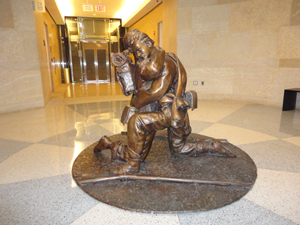 There’s a lesson to be learned for those who say that Virginia is still fighting the Civil War. It comes straight from the halls of the State Capitol—which was once the Confederate capital—to mark the War’s sesquicentennial. The bronze statue is called “Brothers” …and it symbolizes how amidst opposing views and divisive issues, it’s how they’re resolved that makes the nation great.
The life-sized statue depicts two brothers: the older Confederate—poor, weathered, and battled-torn—and the younger Yankee—recently recruited and supplied. On a field of battle, they have set aside their arms and fallen to their knees embracing. One faces the sky as if thanking his Maker for the chance to make amends.
“After the Civil War was finished, Southerners began to organize into camps–United Confederate Veterans and they would establish camps in different cities. Likewise, the Union Veterans would associated together in Grand Army of the Republic posts that began dawning the landscape. And what I can’t help but notice, is that by the 1890’s when Civil War veterans were holding various reunions, they began to invite their counterparts to the same reunions,” says State Capitol Historian Mark Greenough.
The statue is the work of nationally recognized sculptor Gary Casteel … but was donated by an anonymous Virginian.
–Tommie McNeil
Regulations on Timeshares
Posted by Virginia Public Radio in Daily Capitol News Updates on October 6, 2011
 People seem to either love or hate timeshares—and although some say their timeshares have paid for themselves many times over, others find the costly maintenance fees or unfulfilled promises of amenities burdensome. A large number of Virginians have tried to unload their properties but found that they could not.
At first, Delegate John Cosgrove thought of legislation to allow owners to divest themselves of their timeshares, but the state constitution forbids it. So now he’s trying a new approach to help those with problems. “Basically, there are some really unscrupulous groups out there saying, ‘We’ll sell your timeshares, send us 500-bucks,’ and you never hear from them again. Luckily, I haven’t fallen victim to that scam, but a lot of people have.”
His proposed bill does not solve all problems entirely. “But what it does do–it looks forward so that when people sell timeshares they must disclose on a separate piece of paper in larger print that you can’t buy a timeshare as an investment—that resale is very difficult. That once you buy it, it’s for your personal use and, you’re pretty much stuck with it,” says Cosgrove.
It also requires companies that resell timeshare weeks to comply with stronger regulations to do business in Virginia, including describing their costs and consumer benefits. But those who feel cheated will still have to take a timeshare developer to court, and Cosgrove says there have been many such lawsuits in Virginia.
–Tommie McNeil
Virginia General Assembly Elections
Posted by Virginia Public Radio in Daily Capitol News Updates on October 5, 2011

With the election only a month away, the campaigns for all 140 House of Delegates and Virginia Senate seats have kicked into high gear. Dozens of seats are uncontested, but the stakes are especially high in one chamber of the General Assembly.
A number of long-time incumbents are defending their seats. But the Senate is more competitive than the House, with the two major parties vying for control. State Election Services Assistant Manager Matt Abell says the Senate has only 14 uncontested seats. “That leaves 26 contested races of the 40. Twenty-four of the 26 are contested between the major parties—the Republican and Democratic candidates.”
The House has only 37 contested seats, with 27 between the major parties. The rest have Independents, Libertarians, or Independent Greens on the ballot. But Abell says the number of competitive House races has recently declined. “In 2007, there were 59 uncontested House of Delegate races. That dropped to 32 in 2009. And now in 2011, we’re up to 63 uncontested races,” he says.
Virginia will also hold local elections, including those for constitutional officers, supervisors, and school boards.
–Anne Marie Morgan
Insurance Shopping
Posted by Virginia Public Radio in Daily Capitol News Updates on October 5, 2011
 Many consumers don’t know this, but the State Corporation Commission has very extensive shoppers’ guides on buying various types of insurance.
Given the ease of shopping via the Internet, the SCC says it is imperative to know the best practices.
Surprisingly, the SCC lists the top 50 insurance carriers statewide. Although there are a handful of well-known insurers, many more exist, including some that do not have great reputations and offer bargains that turn out not to be so good. The SCC’s Rick Wright says his agency recommends that consumers shop their insurance periodically, even if they’re satisfied.
“What we recommend though is that insurance, when you’re shopping for insurance, you start out with an apples to apples quote. Have your own policy in hand and make sure that whoever you’re dealing with is quoting the same coverage that you’ve got on your existing policy,” says Wright. “And that way, you’ve got a fair measure to go by whether or not you’re getting a better deal or not.”
But Wright says a cheaper deal is not a better deal if consumers do not get equal or better coverage. He says one essential part of auto insurance is the maximum liability coverage paid to each person in a vehicle if you are at fault. The person who’s liable must pay for everything that the insurer does not pay, which can cause financial ruin due to one fender bender. Wright also suggests shopping for umbrella policies that extend the automotive coverage; they are typically less expensive than traditional ones.
-by Tommie McNeil
Making Virginia Law Easier to Understand
Posted by Virginia Public Radio in Daily Capitol News Updates on October 4, 2011
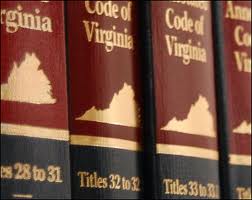 A project that’s a hobby of a Virginia Web developer will soon be made public. It will enable citizens who are not attorneys to find and understand the Commonwealth’s laws.
The goal is to make statutes that appear to be perplexing more interesting and user-friendly.
The Website is the brainchild of Waldo Jaquith, the Web Developer for the University of Virginia’s Miller Center. Jaquith wants citizens to be able to access and comprehend state laws free of charge whenever they need to do so. He told the Virginia Code Commission, which works to update state laws, that the Commonwealth’s current Website is confusing. Jaquith said the laws are more useful when cross-referenced with context.
“I want to take the state Code to connect it with Court decisions, Attorney General opinions, scholarly publications, bills that have been or currently are before the General Assembly that propose to modify the state Code, Legal Aid Societies, legal self-help guides, you name it. Iif we can tie it back to the Code I want to do it in one place on one Website.”
The site also refers to each law’s history and will be automatically updated. It is in the final testing phase and will soon be officially rolled out. Jaquith has received a grant from the John S. and James L. Knight Foundation to develop similar sites for other states.
-by Anne Marie Morgan
Errors in Unemployment Benefits
Posted by Virginia Public Radio in Daily Capitol News Updates on September 29, 2011
 At least 17.6% of Virginia’s unemployment benefits during the last three years were paid in error. That’s according to the U.S. Labor Department … which has targeted the Commonwealth and a handful of other states for special monitoring in an effort to decrease the rate of mistakes. 85% of the overpayments were caused by three errors.
The 3-year total of overpayments was $434-million. 11% of claimants collected benefits after going back to work. 12% were paid before notice was received that their work separation made them ineligible. 62% were paid even though it could not be validated that they met work-search requirements.
Attorney General Ken Cuccinnelli said his office will be advising the Employment Commission about the problem. But he adds that employers had to pay higher taxes to the state trust fund after it was depleted last year. “ We do have businesses that are strained. They’re struggling to keep on the black side of the ledger versus the red side of the ledger. And if we can keep their tax rate from rate from artificially rising—improperly rising—we’ll leave them with more assets to grow, to invest, and to create more jobs,” said Cuccinnelli.
The state budget had to include funds this year to repay interest on federal loans given to keep paying jobless benefits. The state does try to recover improper payments, but it’s now required to submit a strategic plan and be monitored until the error rate falls below 10%.
–Anne Marie Morgan
Inmate Rehabilitation
Posted by Virginia Public Radio in Daily Capitol News Updates on September 29, 2011
 One of the key strategies in incarcerating criminals is rehabilitating them while they’re in prison so that they can become more productive citizens upon their release. However, statistics show that many re-offend … and say they returned to their former lives because they can’t reintegrate into society. But a state Prisoner Re-Entry Policy group led by the Secretary of Public Safety says it will propose a plan that could help reduce those recidivism rates.
Chief Deputy Superintendent at the Virginia Department of Correctional Education Drew Malloy says many proposals will not only make prisoners useful upon release, but while they’re in prison. One of his department’s cost-savers is a commercial drivers’ license program, which will help low-risk offenders find work upon release, but also allow them to be delivery drivers for the DOC for a lower cost than outside contractors. Malloy says they’ve also been concerned about younger offenders.
“The fact is we want the juvenile offenders to come back into the communities so that they can go right back into their old schools if possible, or at least back into their communities with a G.E.D. or a high school diploma, and some cases, post-secondary work already, because we do have community college programs,” says Malloy.
The group will also propose providing housing for youth and adult ex-offenders …and allowing working inmates to deposit some of their wages into accounts that they will have upon release. Another measure would map what each prisoner should do during each stage of incarceration before reentering society.
–Tommie McNeil
Strengthening Families
Posted by Virginia Public Radio in Daily Capitol News Updates on September 27, 2011
 Participants from 14 states and the District of Columbia convened in Richmond for the “Northeast Family Strengthening Conference” hosted by several Virginia state agencies. The programs focused on strategies to build positive family relationships, increase financial assets, improve workforce development, and other best practices. State officials believe a holistic approach could significantly decrease the number of poor and fragile families.
Using federal data, the speakers drew a correlation between higher poverty rates and fractured families … which they said increases dependence on the public sector. “Virginia families that are headed by women have a 31% chance of experiencing poverty, while families that consist of married couples have only a 4% chance, says Lietenant Governor Bill Bolling.
The cost for child support cases and many social services—is nearly $2.4 billion in Virginia per year. “Children who are raised by single parents are at greater risk of dropping out of school. They’re at greater risk for teenage pregnancy, juvenile delinquency, living in poverty, and experiencing health, emotional, and behavioral problems,” says Bolling.
Children living with one parent with an unmarried partner had the highest rates of abuse. A new state initiative is developing multi-prong strategies that include reducing non-marital births, connecting fathers with children, and increasing household income through innovative policies.
–Anne Marie Morgan
Disaster Assistance
Posted by Virginia Public Radio in Daily Capitol News Updates on September 23, 2011
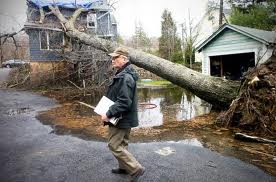 Virginia is in an unusual position of having to ask the federal government for disaster assistance as result of four natural disasters occurring back-to-back. But even if FEMA denies some claims, the Commonwealth will still have to rebuild and find funding to help repair the damage.
FEMA already denied assistance for the tornadoes in May, but has granted SOME funding for the earthquake, Hurricane Irene, and Tropical Storm Lee. Virginia Department of Emergency Management Director Michael Cline told the Senate Finance Committee that the earthquake alone caused $14-million in damage.
Cline says it remains to be seen if FEMA will provide funds for other claims. He said some state costs were mitigated because for the first time, the primary flooding areas had flood insurance. Additional damages include $87 million to private property, $130 million to agriculture, and $52 million in local government costs.
–Tommie McNeil
Virtual Schools
Posted by Virginia Public Radio in Daily Capitol News Updates on September 22, 2011
 Futurologists predicted this day was coming—when children would no longer spend their days in school learning … but work instead in the comfort of their own homes using the latest innovations. But Virginia is still laying the groundwork to make that a reality, and the Senate Finance Committee is examining the cost-effectiveness of virtual schools and how they can provide high-quality education to students.
While several states have adopted Virtual Schools, none has totally submerged its students in a world with no school walls or daily interactions with teachers and others. Allison Powell, the Vice-President for the International Association for K-12 Learning, admits that each state and local jurisdiction will have different needs. States would need universal rules for full implementation and some regions may still have funding challenges based on the variety of schools and courses they offer.
“You do still have the administrative piece of running a school, the instruction is a little bit different, they’re not necessarily using textbooks. Some of these companies do ship out boxes of books and videos, and science kits, and all that kind of stuff as well, so the kid isn’t in these full time programs sitting in front of a computer for eight hours a day,” she says.
Powell says many costs are similar to brick and mortar schools ….but without transportation or building expenses. She says another benefit is providing students with alternative teaching methods designed to keep their attention and use individual learning styles.
–Tommie McNeil
Smog in Virginia
Posted by Virginia Public Radio in Daily Capitol News Updates on September 22, 2011

Ahead of a hearing and vote in Congress on the Environmental Protection Agency’s regulatory policy-making, a group of environmental activists has released a report that details the effects of smog on the Commonwealth. The pending action by Congress could ease EPA regulations. The group says the legislation would allow big industrial companies to further contaminate the environment.
Near House Majority Leader Eric Cantor’s district, the activists and state Delegate Jennifer McClellan urged Virginia’s Congressional delegation to vote against the TRAIN Act, which is spearheaded by Cantor. They say his district and other parts of the state rank among the highest in smog pollution nationwide.
Environment Virginia’s Caroline Kory adds that while the Act’s supporters say EPA regulations hinder job creation, industry leaders ignore data suggesting that those businesses contribute to a decline in health. She says it costs less to address pollution now before the problem gets worse. Delegate McClellan rebuts the claim that regulations harm jobs. She says there’s a nexus between the environment and jobs … such as when cleaner natural resources attract tourists—thus helping that industry.
–Tommie McNeil
[audio https://virginiapublicradio.com/wp-content/uploads/2011/09/pollution.mp3%5DAnti-Gang Documentary
Posted by Virginia Public Radio in Daily Capitol News Updates on September 20, 2011
 Virginians who were members of criminal street gangs share their riveting stories in a new documentary produced by Attorney General Ken Cuccinelli. “The Big Lie” exposes the methods that gangs use to convince children to join their ranks …but also describes the dangerous lifestyle of gangs and the distress of life in prison.
The goal is to prevent children and teens from being lured into a gang’s trap.
The DVD also features resistance strtegies—and will be available through schools and the Attorney General’s office.
–Anne Marie Morgan
-
You are currently browsing the archives for the Daily Capitol News Updates category.

Subscribe to our RSS Feed
 From NPR News
- At the Legacy Museum, facing America's racist past is a path, not a punishment
- A leadership vacuum adds to strains on the CDC
- DHS funding deal on shaky ground as Trump and Democrats both decline to embrace it
- A 92-year-old judge will take on the Maduro case. What do we know about him?
- Yep, a mom's COVID shot during pregnancy protects her baby, a large study finds
- Thousands of U.S. troops deploy to Middle East. And, the latest on DHS funding talks
- Iran rejects Trump's proposal to end the war and lays out 5 conditions, state TV says
- They gave her business a lifeline, then froze all her money
- A shelter village provides a bridge to permanent housing
- Your data is everywhere. The government is buying it without a warrant
- From BBC News
- Ex-Google boss confirmed as new BBC director general
- No 10 refuses to say if key Mandelson texts were lost when top aide's phone stolen
- Bravery medal recipient 'hugged armed man to stop him bombing hospital'
- London Marathon considers two-day event in 2027
- Musketeer d'Artagnan's remains believed found under Dutch church
- Olivia Dean, Lola Young and Lily Allen nominated in top songwriting awards
- Woman-hating teen shared murder plans on Discord before killing mum
- Man who racially abused Jess Carter sentenced
- Hospital waited two days before raising alarm about meningitis outbreak, BBC learns
- Everyday life in Asia being upended by effective closure of the Strait of Hormuz


 Virginia Public Radio