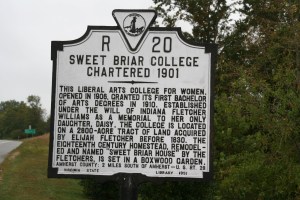
 Striking a balance between development and preserving our environment has always been a challenge. Scientists warn that many of our ways of making a living have a profound impact on nature. There are some folks hard at work devising ways to meet that challenge.
It turns out that the 3000 acre Sweet Briar College campus, once a plantation, is a veritable laboratory of old wetlands, ingeniously diverted underground by settlers more than 200 years ago through a network of clay pipes so that the land above them could be farmed. It’s just one example of how we have frequently thwarted nature, says naturalist-in-residence, Mike Hayslett.
“We have a long history in our country and in our culture of regarding wetlands as an impediment to our progress, whether it’s the initial history of agriculture, it being an impediment to growing the food that we need or an impediment to our perception of progress and the need to change the landscape and other industrial uses and what have you. So we have two centuries or more of approaching wetlands as something that are best moved out of the way and replaced with something else.”
Hayslett is now in the process of locating and dismantling the extensive piping under Sweet Briar’s grounds and restoring the native wetlands. He is not only using his science students , replacing the slave labor that originally installed the pipes, but he is also holding workshops and seminars for professionals who are designing wetlands restoration projects nationwide. Participants in his Swamp School just wrapped up five days of trekking through fields and forests in and around Sweet Briar observing the work he has done so far.
So why is all this important? Marc Seelinger of the Raleigh Swamp School explains. “Easiest example is to take a look at what happened after the hurricane the past couple weeks. The lack of wetlands gave the water no place to go, so just from a flood control standpoint we’ve had massive floodings because the water has no place to be stored. The secondary thing that will happen from that is that there is also a water pollution control feature. Wetlands clean up the water, wetlands are kind of like the country’s kidneys.”
Wetlands are a buffer Seelinger says, and they are the only way to maintain a diversity of living things in our world. Mike Hayslett notes that his restored ponds are proof of the adage that “if you build it, they will come.” Long dormant seeds and terrestrial critters have found their way back to the water where they are once again propagating in great numbers.
Hayslett says his proudest achievement is the partnership he forged with the Boxley Company some ten years ago. Based in Roanoke, Boxley has plants throughout Virginia and West Virginia that supply aggregate, block and concrete for road building and commercial and residential projects. They have given him free rein to relocate wetlands around their quarry near Sweet Briar that might eventually be encroached upon.
“The mission is to be environmental stewards and we had this opportunity to work with Mike to enhance what we have here at Piney River and we jumped at the opportunity.” That’s Jack McCarthy, a Boxley Superintendent, and he says that though their environmental efforts have involved some expense, he is proud that his company has become a recognized and well publicized prototype for such partnerships. Mike Hayslett notes that there is another advantage to this cooperation. “There is a whole system, a legal and financial system, that restoration of wetlands can yield financial credits. It means dollars in the bank to restore wetland habitats.”
Though there have been laws in place since the 1980s mandating the replacement of wetlands invaded by development, cuts in the budgets of federal and state agencies overseeing them have resulted in limited enforcement. So now more than ever, wetlands enthusiasts say they hope that an understanding of good citizenship will lead to the valuing of natural habitats in lieu of destroying them.
-by Libby Fitzgerald



 Virginia Public Radio